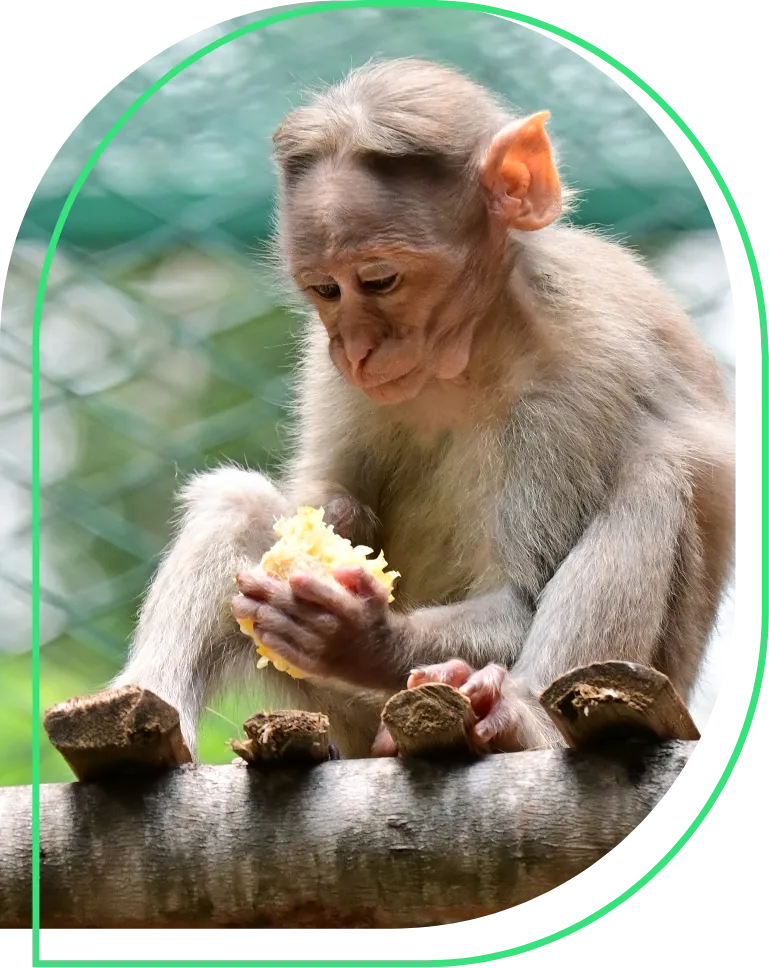
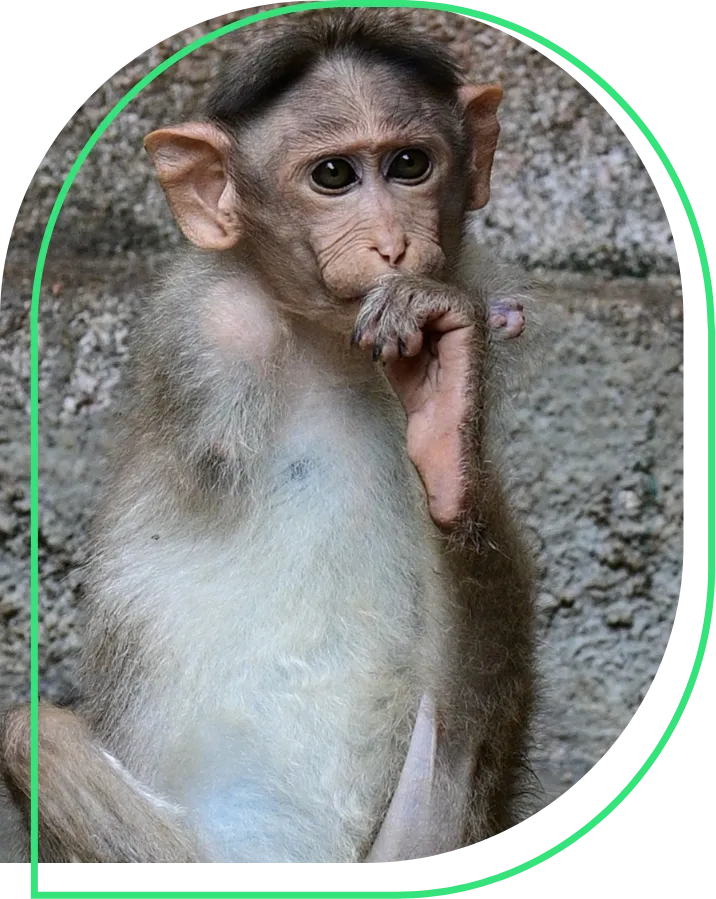
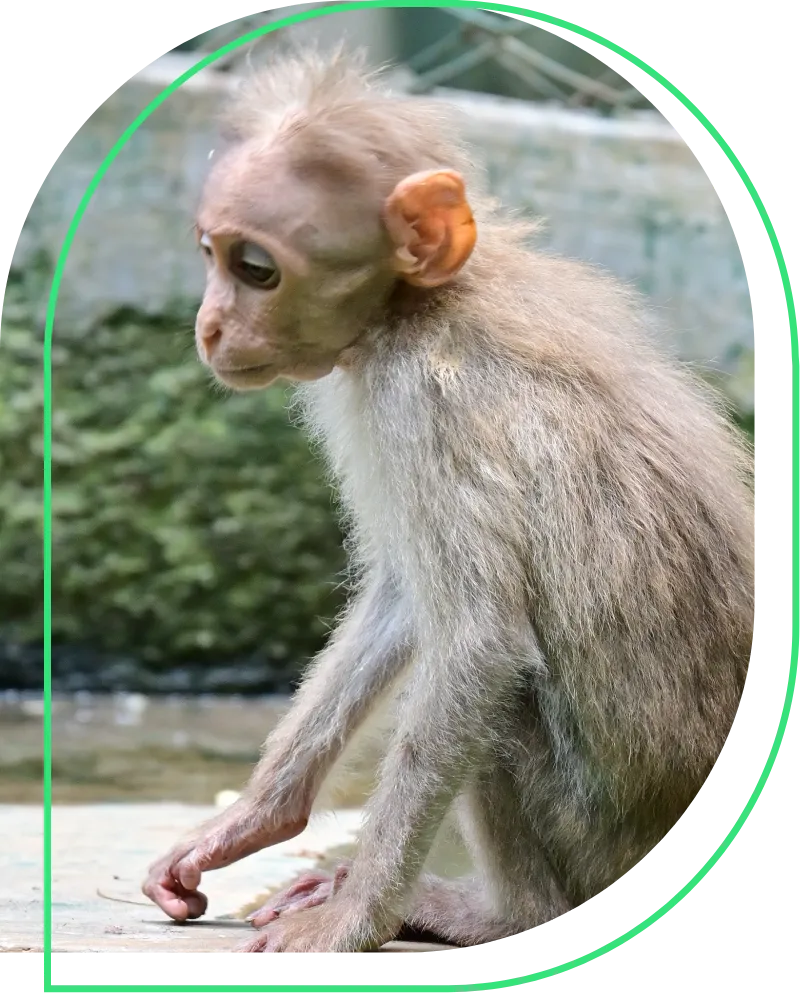
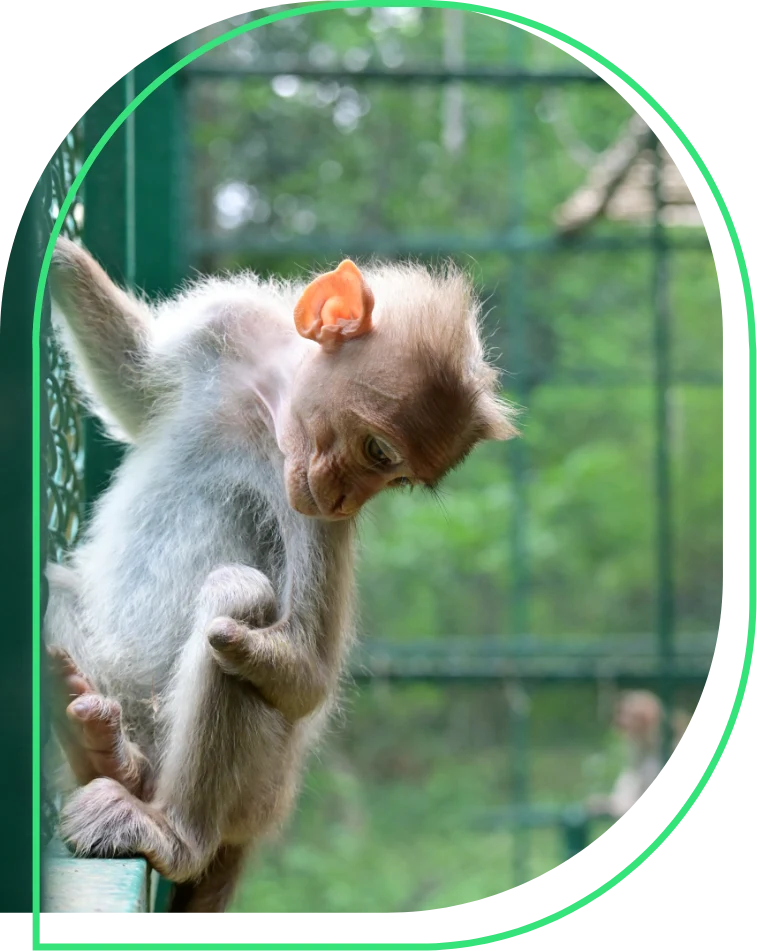
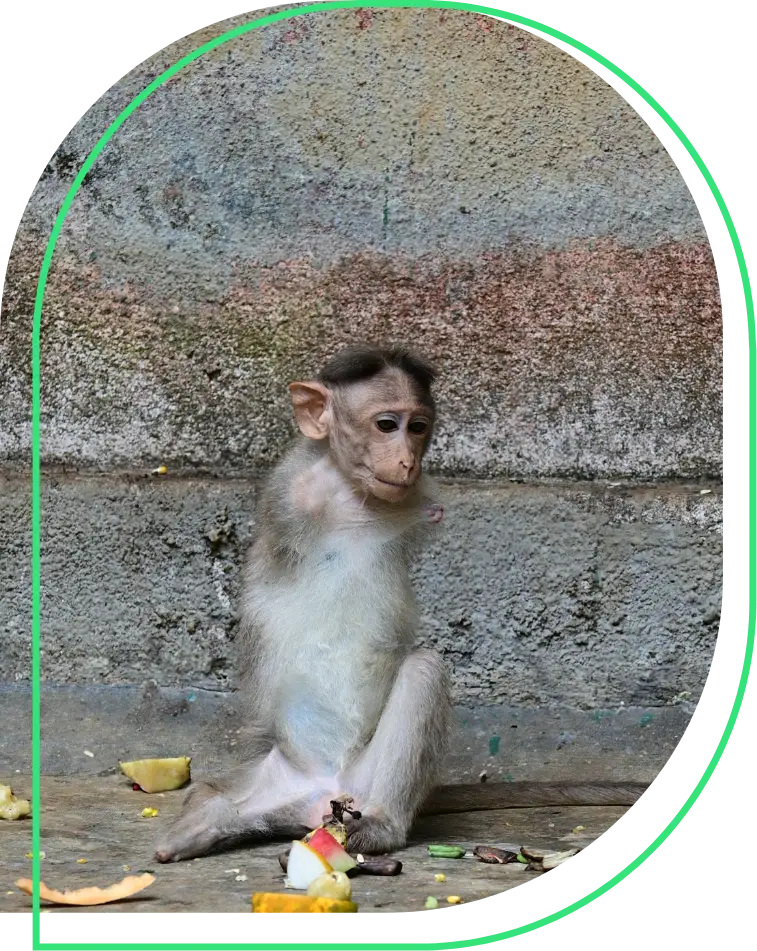
Maya, a young female Bonnet macaque a busy place of urban Bengaluru. She had been kept as a pet, which likely contributed to her initially being very active, curious, and playful, yet completely unaware of her true identity as a monkey. Upon arrival, she was found to have an oral deformity and was kept under quarantine to ensure her health and to begin the crucial process of integrating her into a natural macaque social structure. Despite her unique background, her appetite for fruits and vegetables was good. After a month of observation, she was moved to a larger enclosure with other young macaques. The goal was to help her learn the natural behaviours and social dynamics of a Bonnet macaque troupe. Interestingly, Maya has since become quite assertive within the group, often displaying a “pesky” and active demeanour, even to the point of bullying newer macaques. This newfound assertiveness highlights her adaptation to a more natural social hierarchy, albeit with some challenging behaviors .Passively adopt and aid Maya enabling her back to the wilderness.
Tridev, a young male Bonnet macaque from a busy street of Bengaluru with severe electrocution burns. He presented with affected limbs, a foul odour, and singed hair across his body, indicating a high-voltage electrical shock sustained while attempting to cross the road via electric wires. Despite a grim prognosis, treatment with antibiotics, painkillers, and anti-burn ointments began immediately. His appetite improved significantly with effective pain management. However, the electric current caused complete necrosis in three of his limbs—both forelimbs and his right hindlimb—necessitating amputation. This left him with only his left forelimb intact, ruling out his release back to his natural habitat. Tridev will now reside at BRC for lifelong care. Despite his profound handicap, his spirit remains undimmed; he displays remarkable determination and grit, proving himself agile, mobile, and happy. Once his wounds healed, he was moved to a larger enclosure equipped with platforms, swings, and branches to encourage movement and play, alongside other young macaques for companionship. Tridev thrives in this environment, energetically navigating the space and often engaging in playful “bullying” with other macaques. He has a remarkable ability to help and heal, often guiding other macaques back to their natural behaviors. Passiveey support Tridev and similar traumatized specially abled mokeys.
Kali, a young female Bonnet macaque, was rescued from a rural area , outskirts of Bengaluru , suffering from severe burn wounds across her buttocks, anal region, hind limbs, and forelimbs, suspected to be from electrocution. Upon arrival at WRRC, she was weak, dehydrated, and weighed only 1 kg. Immediate treatment commenced with antibiotics, painkillers, fluids, and topical burn creams, leading to a gradual and remarkable recovery. Presently, all her wounds has completely healed, except for miner health issues.
Passively aid kali back to the spirited monkey she was, due course plan – rehabilitating back to the place when she was rescued from.
Parvati: a tiny Bonnet Macaque, was rescued from Market area of bengaluru . She was a pet in a local home, and though her exact history is unclear, it was reported her mother had died. Barely weeks old, the infant, Parvati, required meticulous hand-rearing at the Wildlife Rescue and Rehabilitation Centre (WRRC). This involved feeding her freshly reconstituted powder milk with sterilized bottles, taking extreme care due to her lack of passive immunity from her mother’s milk.By three months, Parvati was successfully weaned onto solid foods like fruits and vegetables and slowly introduced to other macaques for socialization. However, a male macaque from an adjoining enclosure severely bit her left hand. The tiny, frightened Parvati was rushed into surgery, having lost a significant amount of blood. Despite the grim outlook, Parvati proved to be a fighter and survived, though her left forelimb paw had to be amputated due to severe damage.Parvati’s journey of resilience continues at WRRC. We are currently seeking passive adopters to help cover the costs of her ongoing care, rehabilitation, and ensuring her continued well-being. Your passive adoption will enable her chance at a healthy, fulfilling life.
Bubli: A young female Bonnet Macaque was rescued from bengaluru urban suffering from severe electrocution burns, losing her left hand and right leg. Despite these injuries, she was called Bubli and her remarkable recovery at the Wildlife Rescue and Rehabilitation Centre (WRRC) was astonishing
Bubli is now in a larger enclosure with other young macaques like Tridev, Maya, and Parvati. As highly social animals, this interaction helps them cope with their losses and develop crucial social bonds through grooming and play. Bubli, being a wild rescue, will be a valuable teacher to the other macaques, many of whom were previously pets, helping them learn natural behaviors like showing submission and friendliness within a troupe.WRRC is currently seeking passive adopters for Bubli. Your support will ensure she continues to receive the specialized care needed for her rehabilitation and well-being as she thrives and helps her peers learn essential wild behaviors.
The Wildlife Rescue and Rehabilitation Centre (WRRC) is currently home to parakeets who will permanently remain under care. These birds arrived at the shelter due to a variety of unfortunate circumstances, highlighting the challenges many parakeets face outside of their natural habitats.
Several of the parakeets suffer from alopecia, a condition causing significant feather loss due to bad diet provided in captivity, requiring ongoing specialized attention. Others arrived with clipped wings, a common practice in the pet trade that robs these birds of their natural ability to fly and thrive. The broader issues of the pet trade itself, along with the exploitative practice of parrot astrology, have also contributed to the plight of these birds, often leading to neglect and improper handling. Furthermore, some of these parakeets endured life in small enclosures, where the lack of space severely damaged their feathers and impacted their overall well-being.
At WRRC, these seven parakeets now receive the dedicated care, space, and protection they need, offering them a safe haven from the conditions that brought them to the rescue.
Some bats have ended up in permanent care at the Wildlife Rescue and Rehabilitation Centre (WRRC) because their injuries are too severe for them to survive alone. Common culprits include glue traps, which shred their delicate wings, and electrocution from power lines, causing irreparable damage. Habitat loss due to human activity, like deforestation, also leaves them displaced and hurt. Window and building collisions frequently lead to severe trauma, impairing their ability to fly. Lastly, dehydration, especially during hot spells, often weakens bats critically, making them vulnerable
A few crows are under permanent care at wildlife rescue centers like WRRC due to severe injuries that prevent their release back into the wild. These injuries commonly stem from human-dominated urban environments. A significant threat, especially during kite festivals, is Maanja, the glass-coated kite strings that cause deep cuts, lacerations, and even limb loss when crows become entangled. Collisions with windows and buildings are frequent, leading to head trauma and broken bones as crows misinterpret reflective surfaces. Additionally, contact with power lines can result in severe burns or electrocution. While less common, encounters with urban predators also contribute to their injuries.